
Manufacturing
From a truck of dross to a packed dispatch, on one site.
Eight stages run at MIDC Butibori: intake and segregation, metal recovery, melting, chemistry and casting, rolling, blanking and spinning, quality control, and dispatch. Nothing in that chain is subcontracted.
5,000MT / annum
Production capacity
6acres
Butibori plant
11+units
Melting furnaces
3mills
Rolling mills
12+machines
Spinning machines
97.5–99.5% Al
Ingot aluminium content
The process
Eight stages, in order.
Each stage exists because the one after it depends on it. Sorting decides recovery; recovery decides the melt; the melt decides the chemistry; the chemistry decides whether the circle draws or tears.
- 01Dross & scrap
Feedstock intake
Aluminium dross and process scrap arrive from extruders, die casters, rolling mills and smelters. Each load is assessed and segregated by expected recovery and chemistry before it goes anywhere near a furnace.
- Dross and scrap received and weighed
- Segregated by expected metal recovery
- Sorted by likely chemistry for downstream alloying
- 02Sorting
Recovery & preparation
Dross is the hardest feedstock in aluminium — metal is locked into an oxide matrix. Preparation determines how much of it comes back, which is why this stage decides the economics of everything after it.
- Mechanical preparation of dross
- Separation of recoverable metal from residue
- Residue routed to calcination rather than disposal
- 0311+ furnaces
Melting
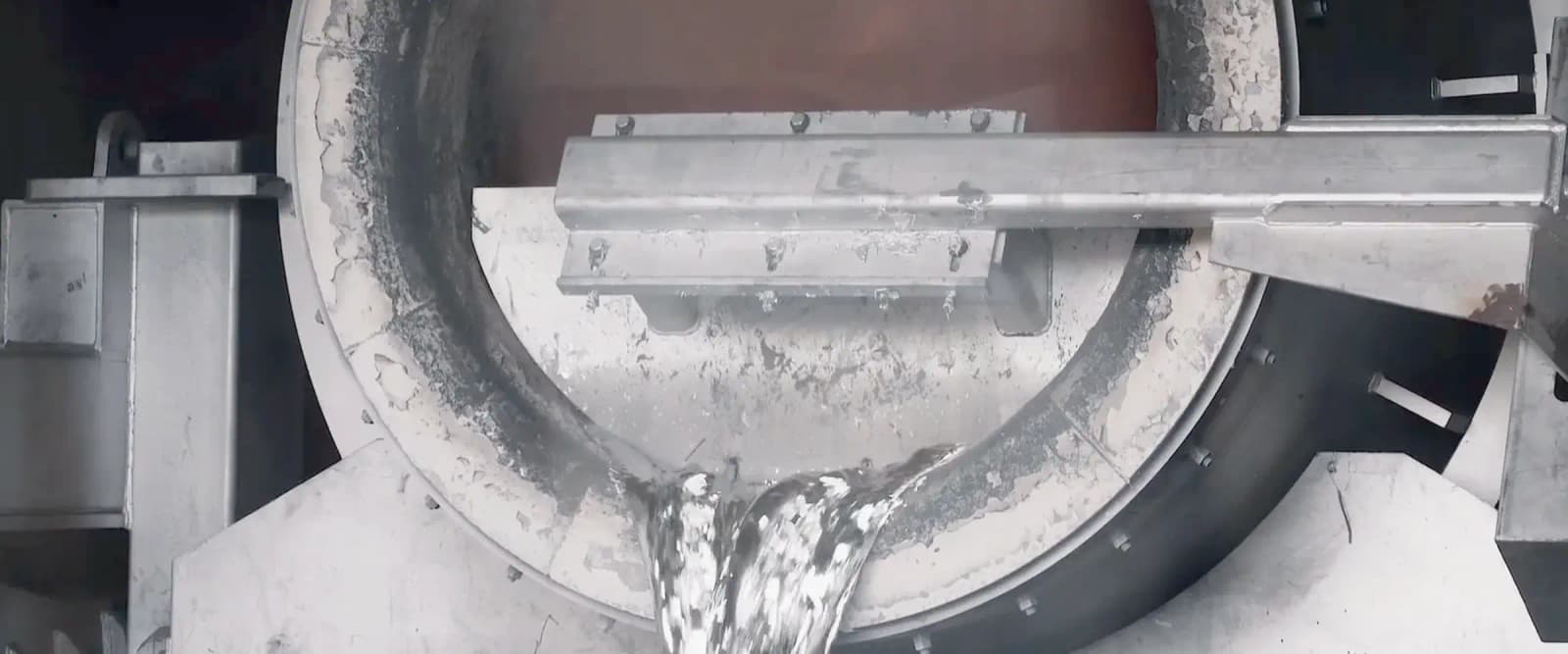
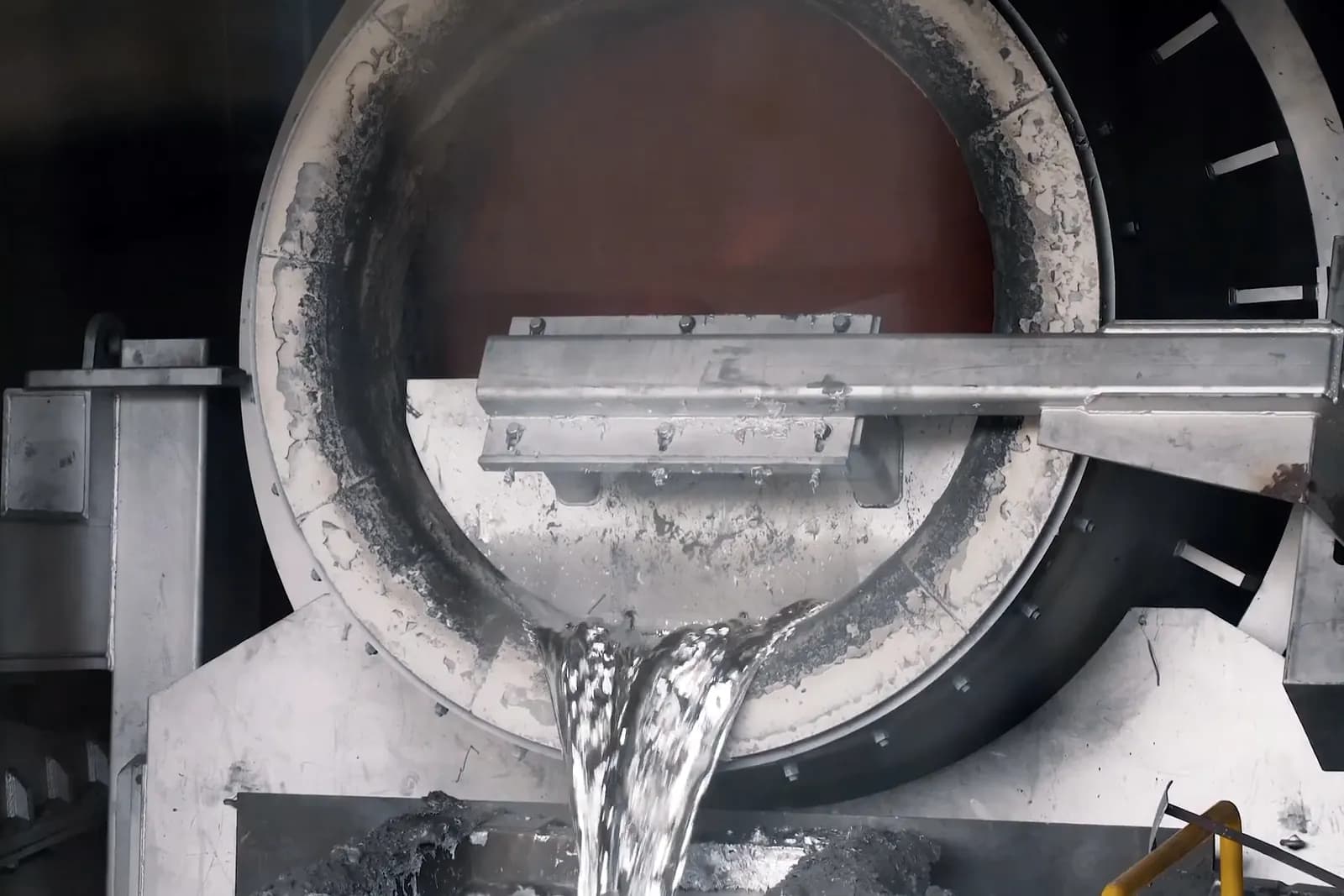
The prepared charge is melted across a bank of 11+ furnaces. Capacity across the bank is what allows repeat monthly volumes to be scheduled rather than squeezed between orders.
- 11+ melting furnaces
- Charge composed against the target composition
- Operated at 7–8% below standard industry coal consumption
- 0497.5–99.5% Al
Chemistry & casting
The bath is brought towards the customer's target composition before it is cast — the difference between a supplier who sells what they melted and one who melts what you asked for. Aluminium content is held between 97.5% and 99.5%.
- Composition adjusted to specification pre-cast
- Aluminium content 97.5% – 99.5%
- Cast to ingot, cooled and stacked
- 053 mills
Rolling
Metal destined for circles is rolled down to gauge across three rolling mills. Thickness is controlled through the pass schedule, because everything a cookware manufacturer cares about downstream depends on it.
- 3 rolling mills
- Reduction to ordered gauge
- Thickness held to agreed tolerance
- 0612+ machines
Blanking & spinning
Circles are blanked to the ordered diameter. Those that stay in-house are formed into utensils on 12+ spinning machines, then trimmed and finished.
- Circles blanked to ordered diameter
- 12+ spinning machines for utensil forming
- Trimming, finishing and polishing
- 07Verification
Quality control
Chemistry is confirmed before casting; gauge, diameter and surface are checked after rolling and blanking; finished pieces are inspected before packing. Test documentation is issued with dispatch where the order calls for it.
- Composition verified pre-cast
- Gauge and dimensional checks post-rolling
- Surface inspection on draw-critical material
- Test documentation on request
- 08Butibori, Nagpur
Packing & dispatch
Packed to protect the surface in transit and dispatched from MIDC Butibori — on the Nagpur corridor, with road access to Central, Western and Southern India.
- Packing configured per product and transit distance
- Dispatch from SZ 30 & 31, MIDC Butibori, Nagpur
- Road access across Central, Western and Southern India
Plant & equipment
What is actually on the floor.
A 6-acre site at MIDC Butibori, laid out so material moves forward through the process rather than back and forth across the yard.
11+
Melting furnaces
A bank of melting units gives the plant enough parallel capacity to schedule repeat monthly volumes instead of fitting them between other orders.
3
Rolling mills
Cast metal is reduced to gauge across three mills. Thickness is controlled through the pass schedule — which is what every downstream deep-drawing operation depends on.
12+
Spinning machines
Blanked circles are formed into utensils in-house, so a customer can buy the blank or the finished piece from identical metal.
—
Calcination
Dross residue left after metal recovery is calcined into alumina powder for refractory, ceramic and abrasive buyers instead of going to landfill.
On coal, plainly: the melting operation is coal-fired, and we run it at 7–8% below standard industry consumption for comparable output. We would rather state that than imply a furnace bank runs on nothing.
Location & logistics
Central India, which is the point.
MIDC Butibori sits on the Nagpur industrial corridor — one of the better-connected points in the country for road freight in every direction. For buyers in Maharashtra, Gujarat, Madhya Pradesh, Telangana and Chhattisgarh, that is a shorter and more predictable haul than the coastal clusters.
Plant
SZ 30 & 31, MIDC Butibori
City
Nagpur – 441122
State
Maharashtra, India
Dispatch
Road freight, all directions
Questions
About how we make it.
What raw material does the plant run on?
Aluminium dross and process scrap, received from extruders, die casters, rolling mills and smelters. The plant does not run on primary metal.
What is aluminium dross and why is it difficult?
Dross is the oxide-rich layer that forms on molten aluminium. The metal in it is bound into an oxide matrix, so it has to be recovered through preparation and separation before it can be melted usefully. That difficulty is why the feedstock is available, and why a plant built to process it holds a position a straightforward remelter does not.
What is your production capacity?
5,000 MT per annum at the Butibori plant, across 11+ melting furnaces, 3 rolling mills and 12+ spinning machines on a 6-acre site.
Can I visit the plant?
Yes. Buyers are welcome at SZ 30 & 31, MIDC Butibori, Nagpur. Call ahead so someone who can answer process questions is available.
Do you make the circles you sell, or buy them in?
We make them. The metal is cast, rolled on our own three mills and blanked on site — so gauge is controlled through the whole chain rather than inherited from an outside roller.
Request a quotation
Want to see the process before you buy?
Come to Butibori, or send us a specification and we will walk you through how we would run it.